Shaping India’s Inclusive Growth Story Through Accessibility
As India moves towards 2047, the centenary year of its independence, the country stands at a defining moment in its development journey. The aspiration of becoming a developed nation is not only about economic growth, infrastructure expansion or global competitiveness. It is also about the kind of society we build, the opportunities we create and the people we enable to participate in this progress.
For India to realise its full potential, development must be inclusive by design. Inclusion cannot be viewed only as a social responsibility or welfare measure. It is an economic, social and moral necessity. A developed India must be one where every citizen, irrespective of gender, age, ability, geography or socio-economic background, has the opportunity to contribute meaningfully to nation-building.
India’s demographic strength is among its greatest advantages. With one of the youngest and most diverse populations in the world, the country has the potential to become a global leader in innovation, enterprise and human capital. However, this potential can be fully unlocked only when access to education, skilling, healthcare, mobility, technology and dignified employment reaches every section of society.
Accessibility is an essential part of this vision. It is often understood narrowly as a requirement for persons with disabilities, but in reality, it benefits a much larger population. Elderly citizens, pregnant women, children, accident survivors, caregivers and many others face barriers at different stages of life. When schools, workplaces, hospitals, transport systems, digital platforms and public spaces are designed to be accessible, they become more efficient, usable and dignified for everyone.
The economic case for accessibility is equally strong. The KPMG–Svayam white paper, Does Accessibility Make Economic Sense?, highlights that India’s official disability figures do not fully capture the real scale of people affected by mobility barriers. It estimates that up to 34% of India’s population — approximately 486 million people — may be affected by reduced mobility. When households and caregivers are considered, the impact extends to nearly half of the population. The paper further estimates that accessibility gaps across tourism, sports, transport and information and communication technology represent an unrealised economic opportunity of nearly USD 191 billion, or approximately ₹16.08 lakh crore.
These figures reinforce an important point: accessibility is not a cost; it is an investment. It can expand markets, improve productivity, increase participation and create new opportunities across sectors. For a country of India’s scale and ambition, universal design must become a core principle in planning, architecture, mobility, digital innovation and public service delivery. Building access from the beginning is always more effective than correcting exclusion later.
The private sector has a critical role in advancing this agenda. Industry can create accessible workplaces, adopt inclusive hiring practices, design products and services for diverse users, and support innovation that addresses real barriers faced by people. Businesses that embrace inclusion are not only doing the right thing; they are also strengthening their relevance, resilience and long-term competitiveness.
Women-led leadership will also be central to India’s progress. Across sectors, women bring perspectives shaped by resilience, empathy, collaboration and problem-solving. Their leadership can help institutions become more responsive to social realities and more committed to equitable growth. However, representation alone is not enough. Women must have real decision-making power, access to resources, mentorship, safety, mobility and equal opportunity.
India has already taken important steps through policies, programmes and national missions focused on empowerment and access. The next priority must be effective implementation. Strong intent must translate into visible change on the ground — in public infrastructure, transport systems, educational institutions, healthcare facilities, workplaces and digital services. Progress must be measurable, accountable and people-centric.
Technology can become a powerful enabler in this journey, provided it is built with inclusion at its core. As more services move online, digital accessibility becomes essential for equal participation. Websites, applications, payment systems, learning platforms and public information channels must be usable by all citizens, including those using assistive technologies. A digitally advanced India cannot afford to leave people behind because of inaccessible design.
At the heart of this vision is a simple belief: dignity must be non-negotiable. True progress is not measured only by the speed of economic growth, but by how widely its benefits are shared. As we look ahead to India@100, we must ask ourselves whether our systems allow every citizen to learn, work, move, lead and live with independence and respect.
India’s future will be shaped by the choices we make today. If accessibility, equal opportunity and human dignity are embedded into our development priorities, India can become not only a developed economy, but also a model society for the world.
As I strongly believe, “An inclusive India will not be built by sympathy, but by systems that create equal opportunity, dignity and participation for all.”
The road to 2047 gives us an opportunity to redefine development itself. Let us build an India where growth is reflected not only in numbers, but in lives transformed, barriers removed and potential unlocked. That is the India we must aspire to create — strong, inclusive, accessible and ready to lead the world.

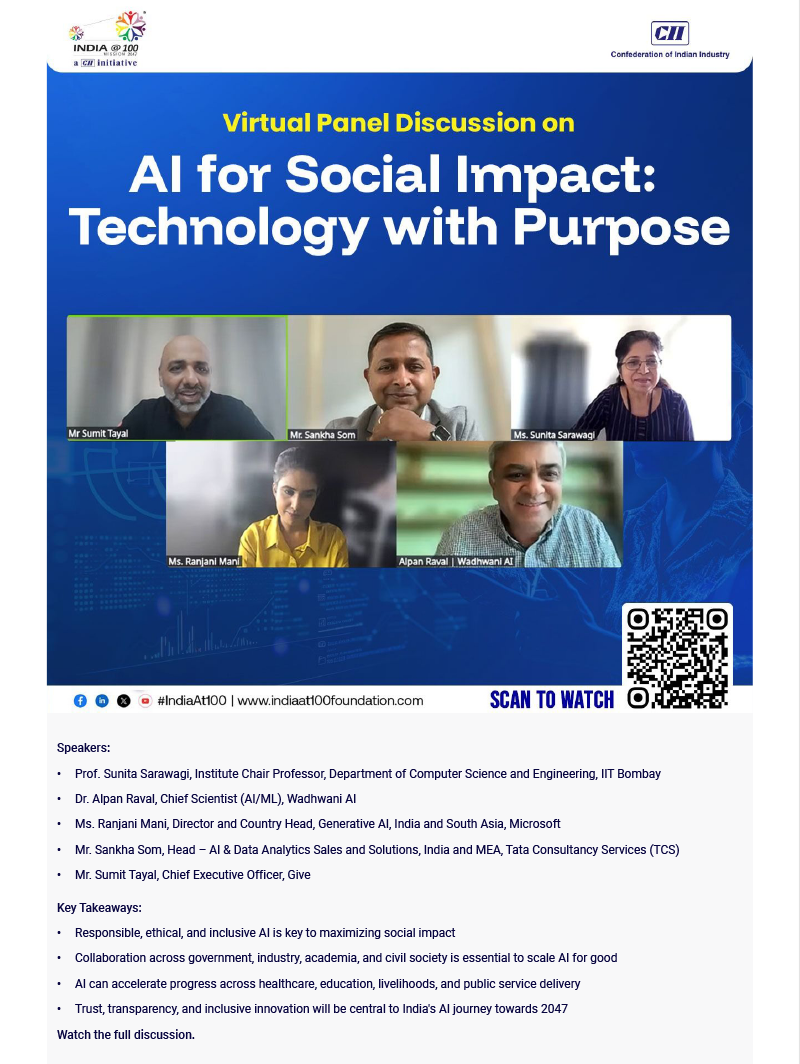
Panel Discussion on
AI for Social Impact: Technology with Purpose
Artificial Intelligence has the potential to transform healthcare, education, livelihoods, governance, and sustainability. Virtual panel discussion on “AI for Social Impact: Technology with Purpose,” featured leading voices from industry, academia, and the social sector on how AI can be harnessed responsibly to drive inclusive and sustainable development.