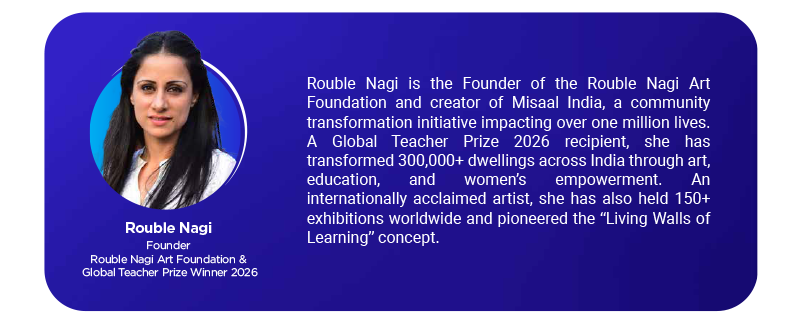
You’ve taken education beyond classrooms into communities—what does an ideal learning ecosystem for India@100 look like to you?For India@100, an ideal learning ecosystem is connected, everywhere, continuous, and inclusive. It does not wait for perfect buildings or policies, it starts wherever a child is. Whether in a government school in a rural village or a private school in a city, the learning experience must be equally rich, dignified, and empowering. Because when education becomes a shared responsibility and a shared joy, we do not just educate children. We transform communities, and through them, the nation. When we look at insights from the CMS Education Survey 2025 – Ministry of Statistics & Programme Implementation, we are reminded that the majority of India’s children—over 55.9%—are in government schools, serving more than 120 million students, while about 31.9% attend private unaided schools. This tells us that the future of India will largely be shaped in government classrooms and rural ecosystems. So the question is not how we create excellence in pockets, but how we standardize opportunity across systems. An ideal ecosystem, therefore, must be designed to function equally in a government school in a remote village and a private school in an urban city. First, it must be deeply connected. Just like nature, learning should not exist in silos. Schools, communities, families, mentors, artists, local professionals, digital tools, and government systems must all interact. When I created Living Walls of Learning, the idea was exactly this: that learning does not belong only inside classrooms, what if there is lack of infrastructure. A wall, a street, a neighbourhood can become a teacher. When children see alphabets, numbers, science, hygiene, or values painted into their everyday surroundings, learning becomes part of life itself, not something separate or intimidating. Communities stop being passive observers and become active partners in education. Secondly, it is continuous. The biggest challenge in India is not just enrolment, it is retention. Many children, especially from underserved backgrounds, drop out due to economic or social pressures. A future-ready ecosystem must support learning over a lifetime, not just during school years. This means building bridges—between school and skill, education and employment, learning and livelihood. Mentorship, vocational exposure, and emotional support systems must ensure that a child does not exit the ecosystem prematurely. Continuity is what converts access into transformation. Thirdly, it includes everything—and everyone. An effective ecosystem is not limited to textbooks. It integrates teachers, digital tools, storytelling, experiential learning, vocational training, and structured curricula into one aligned strategy. But inclusion is the real benchmark. Underprivileged children living in rural villages and slums must not be an afterthought, they must be central to the design. This requires intentional integration: access to the same quality of content, the same exposure to mentors, and the same pathways to opportunity as any child in a private institution. Ultimately, an ideal ecosystem is one where a child’s environment does not limit their potential. It is where learning is constant, inclusive, and deeply connected to life itself. And when that happens, education stops being a privilege for some and truly becomes a right for all. | |||||||
 | |||||||
 | |||||||
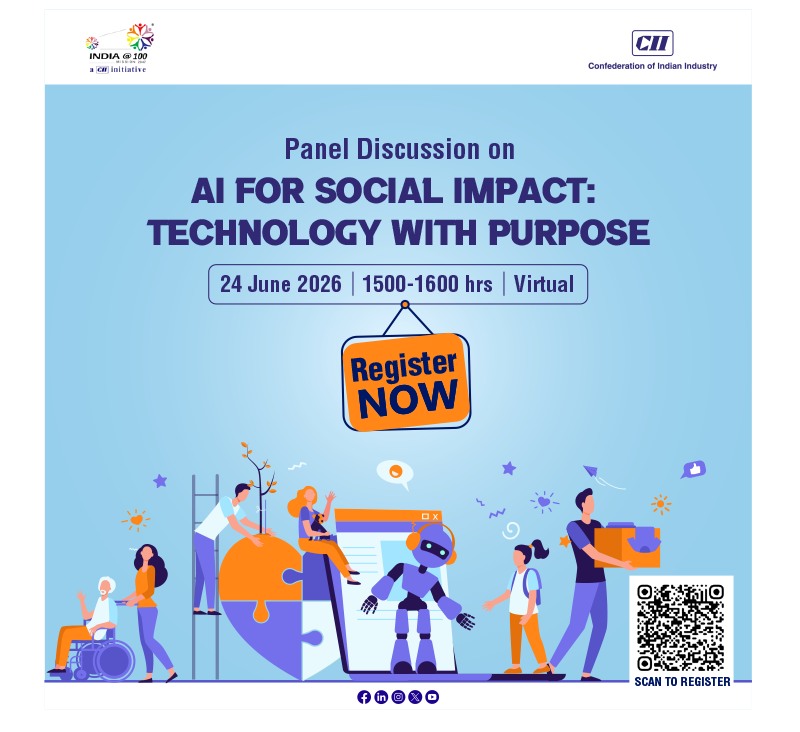
CII India@100 Foundation’s upcoming virtual panel discussion on “AI for Social Impact: Technology with Purpose”, leaders from technology, academia, industry, and the social sector will come together to explore how Artificial Intelligence can drive inclusive and sustainable development in India. The session will examine the transformative potential of AI in addressing real-world social challenges while emphasising the importance of ethical, transparent, and human-centric deployment. Discussions will highlight scalable models, cross-sector collaboration, and pathways to ensure AI serves as a force for public good as India moves towards its centenary in 2047. We invite you to register and join the conversation | |||||||
 | |||||||
 | |||||||
VOLUNTEERING OPPORTUNITIESIndia@100 Foundation has been actively working to mainstream the culture of volunteering among individuals and organizations through specially designed programmes and collaborative platforms. By advocating for a structured volunteering ecosystem, the Foundation seeks to strengthen active citizenship and foster a spirit of collective responsibility toward nation-building. One of its flagship initiatives, National Volunteering Week (NVW), celebrated annually in January, has played a significant role in amplifying awareness and encouraging wider participation in volunteer-driven social impact efforts To further strengthen this vision and provide a scalable mechanism for collaboration, the Foundation introduced the National Volunteering Grid (NVG), (https://indiaat100foundation.com/national-volunteering-grid) a robust digital platform designed to promote and facilitate structured volunteering across the country. The NVG serves as an enabling ecosystem that encourages greater citizen participation, multi-sectoral partnerships, and collaboration among corporates, NGOs, institutions, and communities. By building social capital and promoting inclusion, the platform contributes toward creating a more engaged, responsible, and participative society aligned with the broader vision of India@100. For more information write to us at indiaat100@cii.in | |||||||
 | |||||||
 |  |  |  |  |  |  | |
 |  | ||||||
 | |||||||
 | | | | | | | |